Our next stop after San Jose was the Tarrazú coffee region. Our drive started out a little on the cloudy side. This was our view on the Pan American Highway:

As you can see, anything goes! We got quite a kick out of this "Izuzu", not to mention the pedestrians and bicyclists, cows, horses and tractors that also use the road. It's mostly two lane (sometimes more, sometimes slightly less) and mostly well paved, although we were grateful at times to have the extra height of a small SUV.
We drove up and up and up until we were literally in the clouds! It wasn't quite raining, it was more like a very dense fog. We were happy to have a car in front of us to show us the way on these curvy, winding mountain roads:
 But then, we got over the mountain, saw a few rainbows, and just like that it was a beautiful afternoon!
 We met our host, Elena, in Santa Maria de Dota and she showed us the way to Cabinas Cecelia, the little place where we were staying. Elena offered to meet us at the edge of town and show us in because there was a festival going on in the center of town which closed some roads. Because of the festival, Cabinas Cecelia was completely booked for the night, so she put us in a house all to ourselves across the street from the rest of the cabinas. It was amazing. It was finished being built only three months ago. So we had a kitchen and huge bedroom and bathroom all to ourselves. The funny thing was that none of the appliances worked yet, but we weren't planning on using them anyway so it didn't really matter. You'll see photos of the house later. After settling in, we headed into town to see the festival. This particular festival centers around horses and making them do fancy steps and dances. It was awesome to see so many horses and riders in one place. And clearly there was a lot of pride to be had in showing off your horse. Here's the view walking to town from the Cabinas:
 The sound of all the horses' hooves was really neat. Not something you hear in Princeton every day:
This guy had a particularly pretty horse, and I think he knew it. I love the red decorations:

This little cowboy liked it, too:

It seemed like the whole town (and the next town over) came out for the festival! The streets were packed, there was live music, and of course the horse parade and judging. They also had a midway with food and games and rides. All of the money went to the church in town. Here's Mac thoroughly enjoying his churros:
 They had a tent with about a half dozen foosball tables under it and these games were intense. I loved how the table was shimmed underneath:
There were also a lot of the native people who come to this area from Panama and southern Costa Rica during the coffee harvest. We learned the next day that most of them get Saturday afternoon off, so spending it at the festival made sense. The women and girls all wore these colorful, full length dresses:
 Before the sun set we took a little walk outside of the festival area just to see more of town. We came across this cemetery with all above-ground white tiled tombs. It was quite the contrast to the lush green hills around it. This seemed to be standard for the cemeteries that we saw later in the trip, too.
 The sun set on the valley fairly early and we realized that it gets chilly pretty fast in the mountains once that sun goes away. We walked back up to Cabinas Cecelia and ended up taking a little nap (nothing says "vacation" like a nap nearly every day!), put on some layers and attempted to go to San Marcos, the next town over, to get some dinner. We didn't quite find our way to San Marcos, and instead ended up back in town to get dinner. Not much was open after the festival was winding down, so we ended up getting some pizza and tres leches, a rich, delicious dessert. We also picked up a loaf of bread that came in handy a little later. After dinner we headed back to the cabinas and headed to bed. We had a big day ahead of us on Sunday.
Here's a shot of Mac kneeling down to get the lower branches. His basket is tied around his waist and he's just dropping the cherries into it:

Here's a photo of my hand with some ripe cherries. You can see how sunny it is, even though these are "shade-grown". Also, I kept my long sleeves on the whole time because there were plenty of bugs!

Here is our host Elena:

And this is Norma. She wouldn't smile for the camera at all until a bit later. But you can see she has a smaller basket. Here she's leaning against one of the banana trees:

This is a coffee flower. Apparently they bloom twice a year and usually all at once, so for 3-4 days the entire plantation is full of white flowers and smells wonderful!
 Here are Mac and I with our baskets after about 3 hours of picking. Yes, we're both keeping our day jobs!
 Here Mac is holding the cajuela measure with the beans that he picked inside. He got just under 1/2 a cajuela in about 3 hours.
Here I am with the cherries that I picked. I had just over 1/2 a cajuela for 3 hours of work, and Roberto can pick 15 cajuelas a day!

After measuring out our cherries, we added them to the ones that Roberto and the kids were picking so that they would get paid for our efforts. Then Felix brought us lunch and we all sat down for a delicious meal! Elena and Felix's mom prepared this casado for everyone. It had rice, beans, potato, plantain and this wonderful chayote salad all wrapped in a banana leaf and steamed. Apparently this is how many workers bring their lunch into the field. Roberto and the kids got the same meal and we all sat on the ground, or on tree stumps and ate. Mac, Elena, Felix and I also had a green salad, which Elena said the Bribris won't eat. It had lettuce and carrots from her mom's garden. So delicious!

After everyone was finished eating, the kids were in quite a good mood and even joked around with us a little bit. Here's a deceiving shot of Roger. He's 10 years old and about as tall as my 5 year old nephew:

Roger really liked giving everyone fist bumps, but Norma would only give them to Elena and I. Here is Roger having fun with Mac:
 And here, finally, is a smiling picture of Norma! She really stole my heart and was just the sweetest thing.
 Here's a photo of Mac and I with Roberto, Roger and Norma. This gives you a sense of how small the Bribri people are.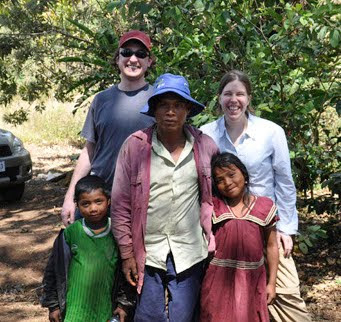
And here's a good shot of Elena, Mac and I:
 Before we left, Mac gave each of the kids 1,000 colones (about $2) and told them to spend it on ice cream. They were quite thrilled with that. We said good-bye and they said Thank You in their native language. I was kind of sad to say good-bye to the kids and Elena. It's amazing how much of a bond you can form in just one morning.
After leaving the farm, we followed Felix through the town of San Marcos to CoopeTarrazú, where he gave us a tour of the Cooperative and explained how coffee goes from what we picked at the farm to a green bean that can be shipped out all over the world.
We started in the Quality Control area and a teenager named Kevin showed us how a cupping is done to test for any flaws in the processing. They roast a small batch of the green beans from each batch that is finished drying and then make four cups of coffee for each batch. Here are 7 different batches, so 28 cups of coffee:

The tasters then sniff and slurp samples from each cup to test for consistency. If they find something wrong with one cup, they get another sample from that batch and make 10 cups, which are then tested. If there is one cup out of the ten that is bad, then they make 20 cups and if one of those is bad, the entire batch is considered not up to quality.

Here's Mac sniffing a freshly made cup:

We also got to slurp and spit from the cups that were on the table. When I first tried it, Felix said I had to make more noise with my slurping. The idea is to spread a small amount of coffee over your entire tongue, swish it around a bit and then spit it out. There are tasters on hand 24-hours a day because they have to test the coffee as it is finished before it goes into the silos that are full of good, finished coffee. If one bad batch goes into a silo, then a million pounds of coffee are ruined. You can see how important a job it is to be a taste-tester here.
After the QC room, we headed into the processing plant and learned about how coffee goes from raw cherry to dried green bean. We were lucky enough to catch a truck coming in to drop off a load of raw cherries. They are measured by fanega and then deposited into this huge vat. A fanega is equal to 24 cajuelas.

Here you can see how big the vat is. We were there on a Sunday toward the end of the season, so it wasn't too busy, but during the week in the middle of the harvest season there can be trucks at all eight stations and trucks still waiting in line.

The coffee is then sorted by weight, which is indicative of quality. The heavier the cherry, the higher the quality. It goes through sorting, and then the beans are removed from the cherry. Felix went into detail about how the plant at CoopeTarrazú has reduced its water consumption by 80% over the last 10 years. The entire process of moving the cherries and beans from place to place within the plant used to be done with floating them on water, but now they use conveyor belts (which he called "rubber bands") for most of it. They also collect the mucus that surrounds the bean on the inside of the cherry and use it to water a field of wheat that is close to the plant. The wheat is then harvested and sold through other parts of the Coopertive. They have a supermarket, gas station, and agricultural & hardware store.
Here's a photo of Felix and I at one of the highest points in the processing plant. You can see conveyor belts on either side of us that move coffee from the sorting part of the plant to the drying part.
 The coffee is dried in stages using different methods of heating it up while moving it around. There were huge machines called John Gordons that used heat created by burning the parchment that is produced later in the process. This is another way that waste was reduced in the process, and something that was just thrown away is now used as fuel instead of wood. CoopeTarrazú even buys extra parchment from other smaller processors, so they also gain profit from what would have been thrown away.
So after about 2 months of processing, the coffee is finally ready to be shipped as a green bean to roasters all over the world. Most of what CoopeTarrazú produces is purchased by Starbucks, but they also have international buyers in Japan, Europe and Australia.

Felix spent about 2 hours with us at the processing plant and it was amazing how much I learned about coffee production. Mac and I both commented later that it was a tour that would never be allowed in the US. The only protection they gave us was a hard hat and we were right in the production part of the plant - no glass walls, nothing to keep us away from the product. In fact, at one point we were walking across nearly finished coffee. It was truly an "insider's view" into what goes into making coffee.
After the tour we drove back to Cabinas Cecelia, got cleaned up and took a nap (you sense a pattern forming?) and then headed back to San Marcos for dinner. On the drive back to San Marcos we noticed coffee everywhere.
 Before heading to dinner we walked around town a little bit and got to see the town's church. It has distinctive blue domes that can be seen from far away when you're driving into the valley:
 We went to a restaurant called Tachito which was recommended by Felix. We had a lovely dinner and tried some of the Costa Rican beer which tasted great because it was served ice cold. Here is a map of the local region, including Tarrazú, that was hanging in the restaurant:
 Here is more shade-grown coffee along the side of the road, with a sign for preventing forest fires. The coffee is the bushy plant lower to the ground (just below the height of the sign) and the shade trees are the taller ones planted amongst the coffee:
 After a long day of coffee picking and learning about coffee, we headed back to Cabinas Cecelia and watched the Super Bowl in Spanish while we did some laundry in the sink, journaled, and got ready for our next adventure tomorrow. Felix was very excited about the Super Bowl and said that he loves all of the NFL, but was rooting for the Steelers. Too bad they didn't pull through.
 The next morning started with another amazing breakfast by Cecelia. Pretty much the same as the day before but this time we got to eat in this outdoor area across the street from our little house, where the other cabinas are. It was a beautiful little area and we saw hummingbirds flitting around the flowering trees and bushes. Cecelia said that the night before, after the festival, that this place was littered with beer cans from the party-goers. That's why she brought breakfast to us over at the house the day before. I'm glad we got to enjoy one meal in this nice outdoor area.
 Here's another view from the breakfast table:
 This is a shot of our house that we had all to ourselves. It was really lovely to have so much space and it was fairly quiet and peaceful, except for the fireworks that went off at 5am both mornings we were there. We asked Elena about it and she said that it has something to do with the festival and that it didn't happen every day.
 This is the kitchen space where we ate breakfast the first day. None of the appliances were working, but it didn't matter since we weren't planning on cooking, although it would have been nice to throw our water bottles into the fridge. Here is Mac writing our Thank You note to Cecelia, who was a wonderful host:
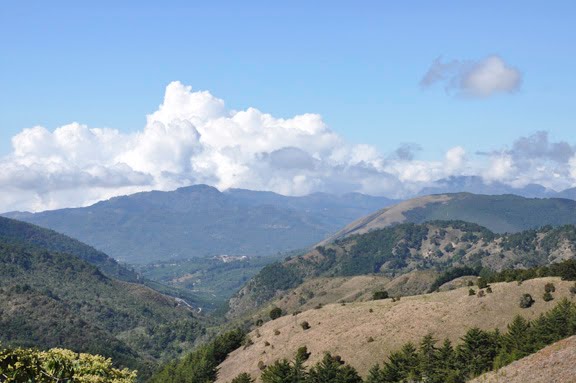
It was another beautiful day for driving and Mac and I did a pretty good job of sharing the driving responsibilities. Here's a view over the valley:
 One of the craziest things about driving in Costa Rica is that sometimes the road has collapsed into the valley below. So, instead of fixing it or giving you any sort of warning that your lane doesn't exist coming up, you just get a little arrow telling you to move over into oncoming traffic!! We noticed this on the way into Santa Maria de Dota, and I was able to get a photo kind of showing it on the way back out of the valley:
 At one point later in the trip this type of road collapse was only marked by a tree stump with yellow tape around it. I would say that fixing the roads isn't a top priority here!
On to Orosi for the next part of our trip!


